12 Best South Korean Food And Dishes To Try
You’re standing in a Seoul food alley at 8 PM. There are 15 stalls, none with English menus, and you have no idea what half the bubbling pots contain. Which dishes are worth your time, and which are tourist traps?
South Korean food has exploded globally, but the real versions — the ones locals eat daily — can be confusing for a first-time visitor. This guide covers 12 essential dishes, what makes each one distinct, and how to order them with confidence. No fluff. No affiliate links. Just the food.
1. Kimchi — The Fermented Foundation You Cannot Skip
Kimchi is not a side dish. It is the national identity in a jar. Every meal in Korea comes with it, and there are over 200 documented varieties.
The base is napa cabbage or Korean radish, salted, then fermented with gochugaru (Korean red chili flakes), fish sauce, garlic, and ginger. The result is sour, spicy, and packed with lactic acid bacteria — live probiotics that survive the fermentation process.
Why it matters for travelers: Kimchi is served automatically at nearly every restaurant. You don’t order it. It just appears. The version you get at a samgyeopsal (pork belly) house will differ from the one at a doenjang jjigae (soybean paste stew) spot. Older, more fermented kimchi is used for cooking. Fresh, younger kimchi is eaten as a side.
Common mistake: Assuming all kimchi tastes the same. Baechu kimchi (cabbage) is the standard. Kkakdugi is cubed radish kimchi, crunchier and milder. Oi sobagi is cucumber kimchi stuffed with scallions. Try all three if you can.
Failure mode: Some travelers find the fish sauce smell off-putting. If you’re sensitive, ask for kkakdugi — it uses less fish sauce and has a cleaner flavor profile.
2. Korean BBQ — The Interactive Meat Experience
Korean BBQ is not a dish. It’s an event. You grill raw meat at your table, wrap it in lettuce with ssamjang (a thick, spicy dipping paste), and eat it in one bite.
The two most common meats are samgyeopsal (thick-cut pork belly, unmarinated) and bulgogi (thinly sliced beef marinated in soy sauce, sugar, pear, garlic, and sesame oil).
| Meat | Cut | Marinated? | Typical Price (Seoul, per serving) |
|---|---|---|---|
| Samgyeopsal | Pork belly | No | ₩12,000–₩16,000 |
| Bulgogi | Beef sirloin | Yes | ₩15,000–₩25,000 |
| Galbi | Beef short rib | Yes | ₩25,000–₩40,000 |
| Chadolbaegi | Beef brisket | No | ₩18,000–₩22,000 |
How to order: Walk into any BBQ restaurant. They’ll ask how many servings. Order 2 servings per person for a full meal. The server brings the raw meat, a gas or charcoal grill, and a basket of lettuce and perilla leaves. You grill it yourself. Medium-rare is not a thing here — Korean BBQ is cooked fully through.
Common mistake: Not using the ssamjang correctly. Take one lettuce leaf, dip a piece of grilled meat into ssamjang, add a slice of raw garlic and a green chili pepper, wrap it tight, and eat it whole. Do not use chopsticks to assemble the wrap — use your hands.
When NOT to go: If you’re vegetarian, skip Korean BBQ entirely. The grills are shared, and cross-contamination is guaranteed. Order kimchi jjigae or soondubu jjigae instead.
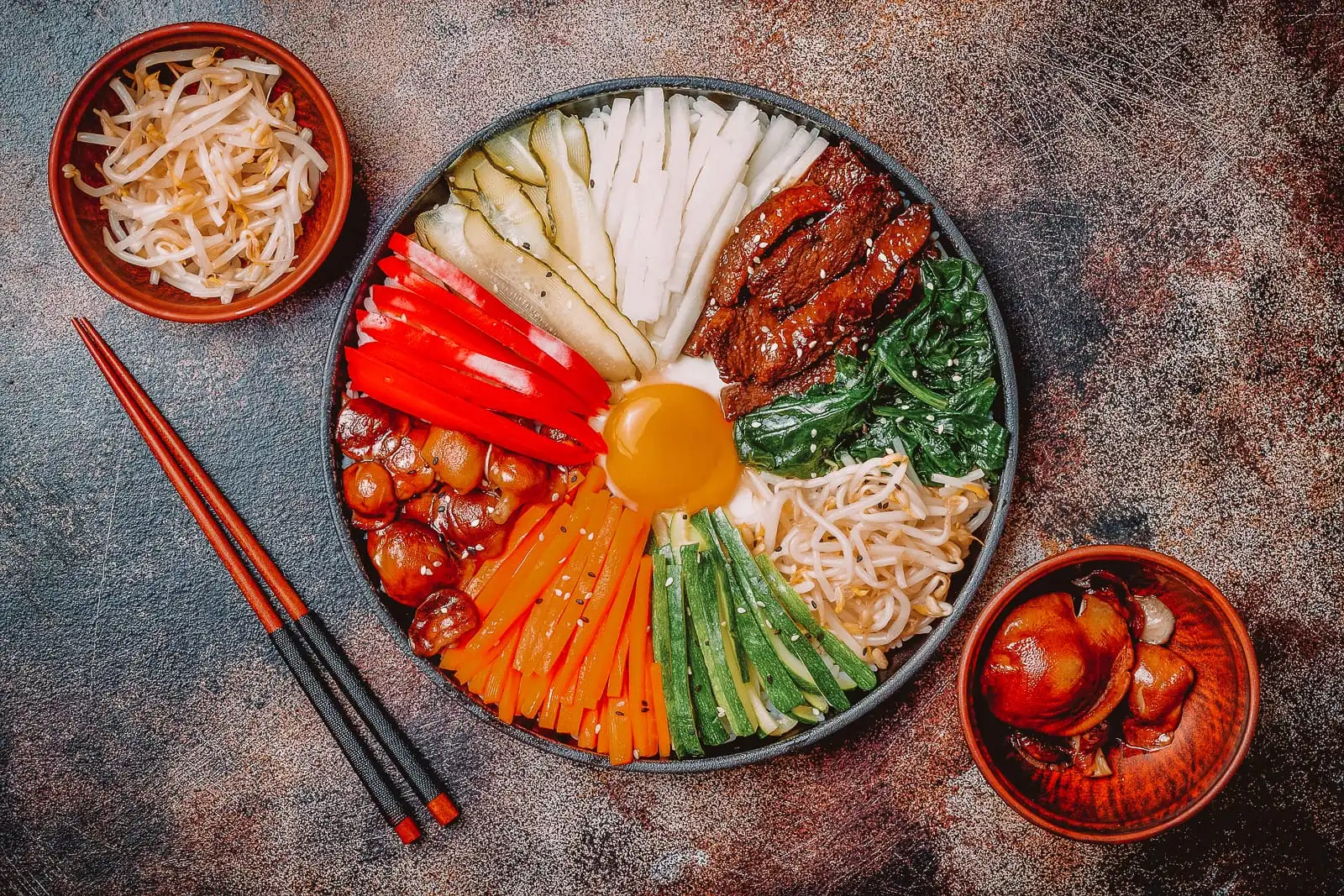
3. Bibimbap — The Rice Bowl That Chefs Compete Over
Bibimbap literally means “mixed rice.” In its simplest form: a bowl of warm white rice topped with sautéed vegetables, beef (optional), a fried egg, and gochujang (fermented chili paste). You mix everything together before eating.
The version you want is dolsot bibimbap — served in a stone bowl so hot it sizzles. The rice at the bottom crisps into a golden crust called nurungji. That crust is the best part. Scrape it up with the spoon.
Common mistake: Adding too much gochujang at once. Start with one spoonful. Mix. Taste. Add more if needed. Gochujang ranges from mild to fiery depending on the brand.
Why it works for travelers: It’s one of the few Korean dishes that is reliably vegetarian-friendly if you ask for no meat. Most restaurants will accommodate this.
4. Tteokbokki — Spicy Rice Cakes from Street Carts
Tteokbokki is the most popular street food in South Korea. Chewy cylinder-shaped rice cakes simmered in a sauce of gochujang, gochugaru, and sugar. Often served with fish cakes (eomuk), boiled eggs, and scallions.
A single serving costs about ₩3,000–₩5,000 from a street cart. The texture is the point — the rice cakes should be soft but still have a firm bite. Not mushy. Not hard.
Where to find the best: Sindang-dong Tteokbokki Town in Seoul. This neighborhood is dedicated entirely to tteokbokki. Every restaurant has its own sauce recipe. Try two or three and compare.
Failure mode: Tteokbokki from tourist-area carts is often pre-made and reheated. The rice cakes become rubbery. Look for a cart where the vendor is actively simmering a fresh batch in a large flat pan. That’s the sign of quality.
5. Japchae — The Glass Noodle Dish You’ll Order Twice
Japchae is stir-fried sweet potato glass noodles with vegetables and beef. The noodles are chewy and translucent. The sauce is soy sauce-based with a touch of sesame oil and sugar.
Unlike most Korean dishes, japchae is served at room temperature or cold. It’s a common banchan (side dish) but also appears as a main course at Korean-Chinese restaurants.
The key ingredient: Sweet potato starch noodles. They have a distinctly bouncy texture that wheat noodles cannot replicate. When cooked correctly, they should be springy, not sticky.
Common mistake: Thinking japchae is served hot. It’s not. If you get a hot bowl, it’s probably a different dish (like japchae bokkeum). Cold japchae is intentional and delicious.
6. Kimchi Jjigae — The Stew That Fixes Everything
Kimchi jjigae is a stew made from aged kimchi, pork (or tuna), tofu, and gochugaru. It’s the Korean equivalent of chicken soup — comforting, cheap, and found everywhere.
Why aged kimchi matters: Fresh kimchi is too mild for stew. The older, more fermented kimchi provides the sour depth that makes the broth complex. Restaurants mark their kimchi age with stickers. The darker the kimchi, the better the stew.
How to eat it: Serve over steamed rice. Use a spoon to break the soft tofu into the broth. The pork adds fat that rounds out the acidity. If you’re vegetarian, order the chamchi kimchi jjigae — made with canned tuna instead of pork.
Price range: ₩6,000–₩9,000 for a single serving. One of the cheapest hot meals in Korea.
7. Samgyeopsal — The Pork Belly You Grill Yourself
Samgyeopsal deserves its own section because it is the most-ordered meat in Korean BBQ restaurants. Thick slices of pork belly, unmarinated, grilled over charcoal or gas.
The ritual: Grill the pork until the fat renders and the edges crisp. Dip into ssamjang or gireumjang (sesame oil with salt and pepper). Wrap in lettuce with raw garlic, green chili, and a dab of ssamjang. Eat in one bite.
Common mistake: Ordering too little. Koreans typically eat 2–3 servings per person. The meat is fatty and rich, but the lettuce wraps cut the grease.
When NOT to order: If you have gallstones or pancreatitis, the high fat content can trigger symptoms. Order chadolbaegi (thin beef brisket) instead — it’s leaner.
8. Naengmyeon — Cold Noodles for Hot Days
Naengmyeon is a bowl of cold buckwheat noodles in an icy beef broth. Served with sliced pear, cucumber, a boiled egg, and sometimes vinegar and mustard on the side.
There are two main types: mul naengmyeon (in cold broth) and bibim naengmyeon (mixed with spicy gochujang sauce, no broth). Both are served with ice cubes floating in the bowl.
Why it’s hard to find outside Korea: The broth requires hours of simmering beef brisket with radish and ginger, then chilling it until it’s nearly frozen. Most Korean restaurants abroad skip this step and serve lukewarm versions. In Korea, the broth is legitimately icy.
How to eat it: Use scissors to cut the noodles into shorter lengths — they are too long and slippery to eat whole. Add vinegar and mustard to taste. Slurp loudly. That’s considered polite.
9. Korean Fried Chicken — Double-Fried and Saucy
Korean fried chicken is different from American fried chicken. It is double-fried, which removes excess oil and creates a paper-thin, shatteringly crispy crust. The chicken is then coated in sauce or served plain with salt.
The two styles:
- Yangnyeom chicken — coated in a sweet-spicy gochujang-based sauce. Sticky. Addictive.
- Huraideu chicken — plain fried chicken, no sauce. Crispier. Served with salt and pickled radish.
Where to go: Major chains like Kyochon, BBQ Chicken, and BHC dominate. Kyochon’s original fried chicken is widely considered the gold standard. A whole chicken costs about ₩18,000–₩25,000.
Common mistake: Ordering delivery without specifying whole chicken vs. boneless strips. Boneless strips are often drier. Whole chicken with bones has more flavor and moisture.
10. Soondubu Jjigae — Soft Tofu Stew
Soondubu jjigae is a bubbling stone pot of uncurdled soft tofu in a spicy broth. The tofu is so delicate it’s almost custard-like. The broth is typically made with anchovy stock, gochugaru, and garlic.
You crack a raw egg into the pot while it’s still boiling. Stir it in. The egg thickens the broth slightly and adds richness.
Variations: You can order it with beef, pork, seafood, or just vegetables. The seafood version (haemul soondubu) includes shrimp, clams, and mussels.
Price: ₩8,000–₩12,000. Comes with a bowl of rice and several banchan.
Failure mode: The pot stays hot for 10 minutes after serving. Do not touch the sides. Warn children. The stone retains heat far longer than it looks.
11. Kimbap — Korean Seaweed Rice Rolls
Kimbap is often compared to Japanese sushi rolls, but the comparison is lazy. Kimbap uses sesame oil instead of rice vinegar. The fillings are cooked (beef, egg, spinach, pickled radish, carrot). No raw fish.
It’s the Korean equivalent of a sandwich. Portable. Cheap. Eaten for lunch, picnics, or late-night snacks.
Where to get it: Convenience stores sell pre-made kimbap for ₩1,500–₩3,000. Better versions come from dedicated kimbap shops (kimbap cheonguk). A fresh roll costs about ₩3,500.
Common mistake: Biting into a whole roll. Kimbap is meant to be eaten in one or two bites. If the roll is too large, use chopsticks to dip it in the accompanying sauce, then bite.
12. Hotteok — The Sweet Pancake You’ll Crave in Winter
Hotteok is a filled pancake sold by street vendors from October through March. The dough is made from wheat flour and glutinous rice flour. It’s filled with brown sugar, cinnamon, and chopped peanuts, then fried on a griddle until the outside is crispy and the inside is molten.
One hotteok costs about ₩1,000–₩2,000. The vendor flattens the dough ball on the griddle using a special metal circle press. Watch for that press — it’s the sign of a proper hotteok vendor.
Why it matters: It’s the only Korean street food that is purely sweet. Everything else is savory or spicy. Hotteok is the dessert option.
Common mistake: Biting into it immediately. The sugar filling is hotter than boiling water. Wait 30 seconds. Blow on it. The filling can cause mouth burns.
When NOT to order: In summer. Hotteok is a winter dish. Vendors switch to patbingsu (shaved ice) in warm months. If you see hotteok in July, it’s probably a frozen reheat — skip it.
The single most important takeaway: South Korean food is built on fermentation, contrast, and shared eating — the best dishes are the ones you eat with others, and the best meals happen when you trust the restaurant to bring you what’s good.