11 Very Best Things To Do In Brittany, France
Most people planning a trip to Brittany make the same mistake: they put Mont Saint-Michel on their itinerary. That abbey is in Normandy. It sits on the Normandy side of the border, and Bretons will politely — or not so politely — correct you on that. Start by getting the geography right, because Brittany itself has enough to fill two solid weeks without borrowing from the next region.
Brittany is a peninsula jutting west into the Atlantic. The coastline is wild and runs over 2,800 kilometers — more than any other French region. The food is serious. The interior is underrated. Here is what is actually worth your time, ranked honestly.
Brittany’s Four Best Coastal Stops (With a Verdict on Each)
The coast is the reason most people come. That instinct is correct. But the coastline is vast and uneven — some stretches are genuinely world-class, others are ordinary. Here is how the main stops compare so you do not waste a driving day on the wrong one.
| Coastal Stop | Best For | Crowd Level (Jul/Aug) | Getting There | Verdict |
|---|---|---|---|---|
| Côte de Granit Rose | Pink rock formations, coastal walking | High | Drive from Lannion (~30 min) | Non-negotiable |
| Presqu’île de Crozon | Sea kayaking, dramatic cliffs, quiet beaches | Medium | Drive from Brest (~45 min) | Best for active travelers |
| Pointe du Raz | Raw Atlantic headland, epic views | High | Drive from Quimper (~1 hr) | Go at 8am before tour buses |
| Île de Bréhat | Car-free island, subtropical microclimate | Very High | Ferry from Pointe de l’Arcouest (~10 min) | Weekdays only in summer |
Côte de Granit Rose: Walk It, Don’t Drive It
The Pink Granite Coast near Perros-Guirec is Brittany’s most photographed landscape. The rocks are genuinely pink — not salmon, not beige — and they are enormous, shaped by millennia of Atlantic erosion into formations locals have named “Napoleon’s Hat,” “The Witch,” and “The Tortoise.” The 12-kilometer Sentier des Douaniers coastal path between Perros-Guirec and Trégastel is the correct way to see them. Budget three hours minimum. Driving between viewpoints loses the entire point.
Presqu’île de Crozon: Brittany for People Who Want to Move
Crozon is where Brittany gets serious about adventure. The peninsula has some of France’s best sea kayaking — the cliffs at Pointe de Pen-Hir drop 70 meters straight into the Atlantic, and paddling below them at sea level is a completely different experience from looking down from the top. Armorique Kayak runs half-day guided trips for around €35–45 per person. The GR34 coastal trail also crosses the peninsula with views that rival anything on the Côte de Granit Rose.
Skip Crozon if you only want scenery from a car window. Go if you want to be in the water or on a trail.
Saint-Malo and Dinan: Two Walled Towns, One Clear Winner
Eastern Brittany has two medieval walled towns within 30 minutes of each other. Most tourists do Saint-Malo. The smarter move is to do both — but know what you are getting into at each one.
Saint-Malo: Worth It, With Caveats
Saint-Malo deserves a visit, but honesty matters here. The Intra-Muros — the old walled city — was 80% destroyed in August 1944 during Allied bombing aimed at flushing out German forces. What stands today is a post-war reconstruction, completed in the 1950s using the original granite. It looks medieval. It is not. That said, the reconstruction is excellent, and the 1.8-kilometer rampart circuit gives genuine views over the English Channel that no amount of historical revisionism can diminish.
At low tide, you can walk out across the exposed sand to Grand Bé islet, where Romantic writer Chateaubriand is buried under a plain slab with nothing on it but his name. The walk takes ten minutes and is one of the more quietly affecting things in Brittany. Check tide tables before you go — the causeway disappears fast and the tidal range here is one of the largest in Europe, reaching 13 meters at spring tides.
Plage du Sillon, the 2-kilometer beach stretching north of the walls, is legitimately beautiful. In July it is also packed. The morning before 9am and the evening after 6pm are the only sensible times to be on it in summer.
Dinan: The One That Still Feels Lived In
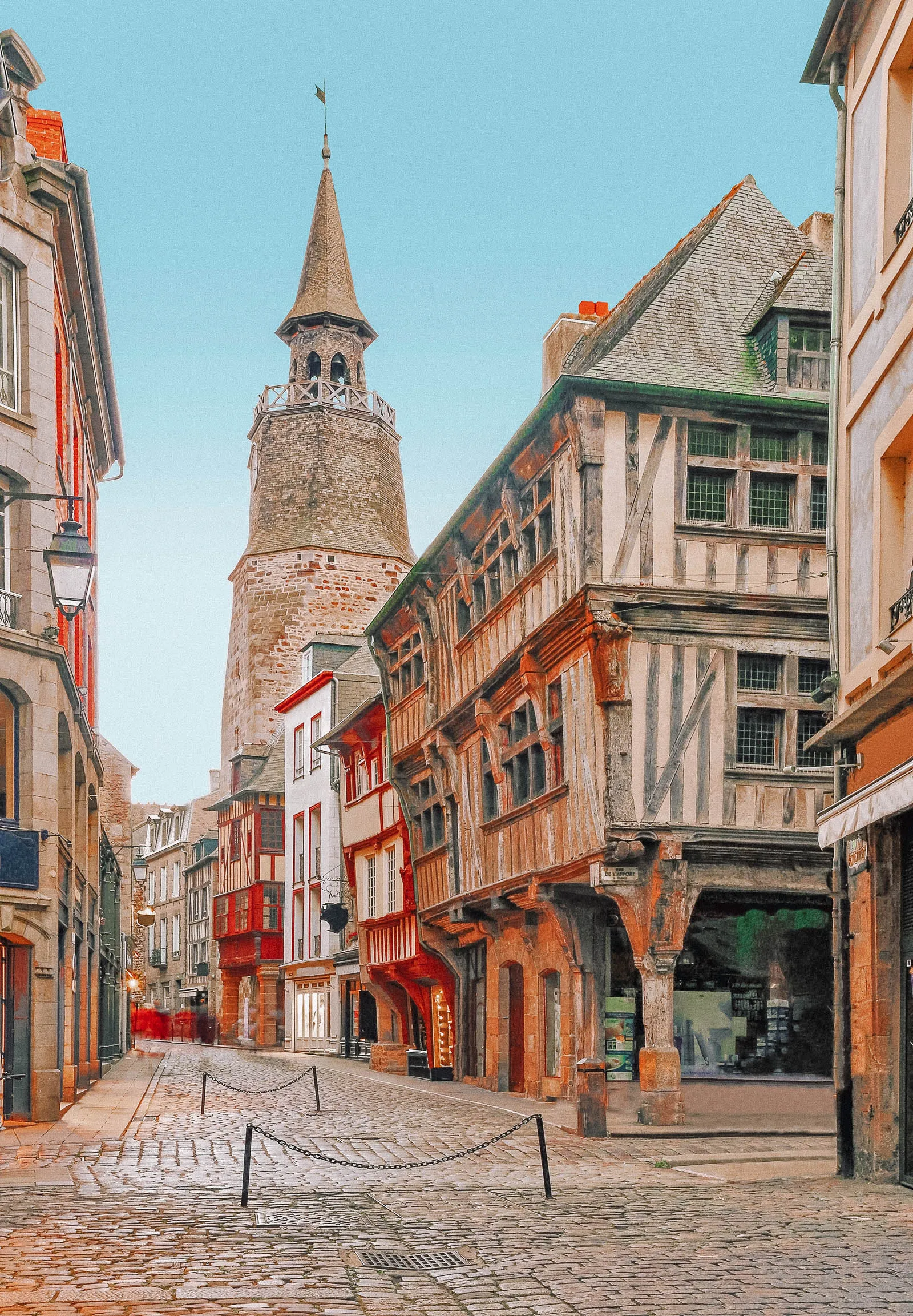
Dinan gets a fraction of Saint-Malo’s visitors and is better for it. The half-timbered buildings on Rue de l’Apport and Rue de la Cordonnerie are original medieval construction — not reconstruction. The town sits on a cliff above the Rance river, and the 2.7-kilometer rampart walk circles the entire old town in about an hour with views over the valley that require no crowds to appreciate.
The port at the bottom of the cliff, reached by descending the steep Rue du Petit Fort, has a cluster of riverside restaurants and a calm that Saint-Malo’s equivalent cannot match. If you are choosing one walled town for your Brittany itinerary, Dinan is the honest answer for most travelers. Saint-Malo is for those who want beaches and a bigger town feel alongside the walls.
One practical note: most shops in Dinan observe a strict lunch closure from 12:30 to 2:30pm. The market at Place du Champ runs Thursday mornings.
Carnac’s Megalithic Stones: Three Questions Worth Answering Before You Go
Are the alignments accessible year-round?
Yes and no. The three main alignment sites — Ménec, Kermario, and Kerlescan — are open year-round, but seasonal fencing restricts access to the areas directly among the stones from April through October. From November to March, you can walk freely between the menhirs. If standing next to the stones rather than viewing them from a perimeter path matters to you, visit off-season. The difference is significant.
Which alignments should you actually prioritize?
Start at Kermario, not Ménec. Kermario has roughly 982 upright menhirs — the densest concentration — and a wooden viewing tower at its eastern end that gives you the scale you need to understand what you are looking at. Ménec has more infrastructure and more visitors. Kerlescan, the easternmost site, is consistently quieter and has a convergence of stone rows toward an enclosure that is genuinely atmospheric in early morning light.
The Musée de Préhistoire de Carnac in town charges €9 admission and is the best context-builder available. The stones themselves offer zero explanation. The museum gives you the Neolithic timeline, the burial practices, the theories. Without it, you are staring at rocks in a field. With it, you are looking at a 6,000-year-old ritual landscape that predates the Egyptian pyramids by over a thousand years.
Is Carnac overrated?
No. It is under-explained. Most visitors arrive expecting Stonehenge-level drama and find flat agricultural land with rows of mossy rocks. That calibration gap is the problem, not the site. Once the age and scale register properly — nearly 3,000 standing stones across 4 kilometers — Carnac becomes quietly astonishing.
What to Eat in Brittany: Four Things That Actually Matter
Brittany has the most distinct food culture in France outside of Alsace. The Breton table is built on buckwheat, sea salt, butter, cider, and shellfish. Don’t shortchange this part of the trip — the food is one of the genuine arguments for visiting the region specifically rather than elsewhere in France.
Galettes vs. Crêpes: Get This Right
A galette is savory — buckwheat flour, filled with ham, Comté cheese, and egg in its classic form (the galette complète). A crêpe is sweet — wheat flour, salted butter, sometimes caramel. In Brittany, confusing them is a minor social failure. The buckwheat used in Breton galettes has a nuttier, earthier flavor than Parisian versions because traditional producers still use local blé noir varieties.
In Rennes, Crêperie Saint-Georges on Rue du Chapitre is reliable and accessible without a reservation before noon. In Quimper — considered the spiritual home of the galette — La Krampouzerie on Place au Beurre is worth waiting for. Avoid any crêperie that shows you a laminated picture menu with photos of every filling. That is the clearest possible signal.
Oysters at Cancale’s La Houle Harbor
Cancale is 15 kilometers east of Saint-Malo and is one of France’s most important oyster-farming areas. The harbor market at La Houle sells oysters directly from the fishmongers — €6 to €9 per dozen depending on size (caillebotis size 2 is the standard order). You take your plate to the quay, squeeze a lemon, eat standing up while looking out over Mont Saint-Michel Bay, and throw the shells over the railing into the water below. There are no restaurants involved. No reservations. Just oysters and the Atlantic.
The market runs approximately 10am to 1pm. Arrive on an empty stomach.
Kouign-Amann: Buy It From a Boulangerie, Not a Gift Shop
Kouign-amann is a caramelized laminated pastry invented in Douarnenez in 1860 — allegedly by accident when a baker ran low on bread ingredients and improvised with leftover dough and excessive amounts of butter and sugar. The result is dense, intensely caramelized on the outside, flaky within, and aggressively rich. The best versions come from boulangeries in Finistère. If it is in a plastic bag with a tourist label on it, keep walking.
When to Go to Brittany
May and early June. The weather sits between 14°C and 18°C, trails are clear, accommodation is easy to find, and you are not sharing the Côte de Granit Rose with a thousand other people. July and August bring real heat, triple the visitors, and accommodation prices that jump 60–80% over the shoulder-season rate. September is the strong second choice — the sea reaches its warmest temperatures then and the crowds thin measurably after the first week. Winter means rain, emptiness, and everything in Carnac accessible on foot. That suits certain travelers perfectly.
The Full 11 Activities: How to Build the Itinerary
Here are all 11 stops ordered geographically from east to west, which is the logical driving direction and avoids doubling back across the peninsula:
- Eat oysters at Cancale’s La Houle harbor market — make this your first morning, coming from Saint-Malo or arriving from Normandy. Non-negotiable opener.
- Walk Saint-Malo’s ramparts and cross to Grand Bé island at low tide — 3 to 4 hours total; check tide tables the night before.
- Spend an afternoon in Dinan — 30 minutes south of Saint-Malo; walk the ramparts and descend to the port for dinner. Half-day minimum.
- Take the ferry to Île de Bréhat — ferry from Pointe de l’Arcouest, about €16 return; the island is car-free and takes 2 to 3 hours to explore on foot. Arrive at the first morning ferry in summer.
- Hike the Côte de Granit Rose Sentier des Douaniers — the full 12-kilometer trail between Perros-Guirec and Trégastel takes 3 hours; arrange a shuttle or taxi back to the start.
- Walk the Forest of Brocéliande (Forêt de Paimpont) — central Brittany’s Arthurian heartland; trails begin at Paimpont village and range from 1-hour circuits to full-day routes. The Val sans Retour is the landmark walk.
- Visit Château de Josselin — a 13th-century castle on the Oust river with three towers visible from the medieval town below; open daily April through September, €9.50 admission. The interior is a working family home and the guided tour reflects that.
- Eat galettes in Quimper and visit Cathédrale Saint-Corentin — Finistère’s capital has the best galette concentration in the region and a Gothic cathedral with twin spires misaligned by eight degrees; the misalignment is deliberate, or at least that is the local consensus.
- Spend a morning at the Carnac alignments — start at Kermario, then Kerlescan, then the Musée de Préhistoire; budget 2 to 3 hours for the sites plus 90 minutes for the museum.
- Kayak or hike Presqu’île de Crozon — base yourself in Crozon village; book Armorique Kayak in advance for summer dates, or pick up the GR34 trail at Camaret-sur-Mer for a full-day coastal walk.
- Stand at Pointe du Raz at dawn — the westernmost headland in mainland France, 72 meters above the Atlantic. Go before 9am. The car park fills with tour buses by mid-morning and the experience changes completely.
A car is mandatory for this list. Brittany’s rail network connects Rennes, Brest, and Quimper, but every coastal highlight requires driving. Budget 10 to 14 days for the full itinerary without rushing. Eight days is realistic if you drop Brocéliande and Josselin.
Start in Cancale, eating oysters off the quay with Mont Saint-Michel Bay in front of you — the one that belongs to Normandy, not Brittany. End at Pointe du Raz watching the Atlantic from the actual edge of the peninsula. That is the trip, built entirely from what Brittany actually is, not what people mistakenly tack onto it from next door.